Museum Membership App
Museum Membership App
For Stanford's Cantor Arts Center
Role
Role
UX Generalist
Disciplines
Disciplines
User research · Wireframing · Usability testing · Hi-fi prototyping
Type
Type
Self-directed concept project
Context and Problem
Context and problem
Cantor Arts Center at Stanford gives its members exclusive events and discounted programming. But the only ways to find out about them were a monthly newsletter and the museum's reception desk - no app, no central hub, no easy discovery. Members were missing events they wanted to attend, not because of a lack of interest, but because the experience didn't match their digital expectations.
Cantor Arts Center at Stanford gives its members exclusive events and discounted programming. But the only ways to find out about them were a monthly newsletter and the museum's reception desk - no app, no central hub, no easy discovery. Members were missing events they wanted to attend, not because of a lack of interest, but because the experience didn't match their digital expectations.

User Research and Analysis
Five in-depth interviews with museum members revealed three critical pain points that shaped the entire design direction.
Five in-depth interviews with museum members revealed three critical pain points that shaped the entire design direction.
Finding 1:
Users don't read email announcements
Senior members don't check emails regularly
Younger patrons are overwhelmed by email volume
Museum emails get lost in crowded inboxes
Senior members don't check emails regularly
Younger patrons are overwhelmed by email volume
Museum emails get lost in crowded inboxes
Finding 2:
Limited opportunities to buy tickets or book events
Only accessible via newsletter link or email invitation
In-person purchasing at museum reception
No mobile or digital booking option
Only accessible via newsletter link or email invitation
In-person purchasing at museum reception
No mobile or digital booking option
Finding 3:
No single source of information about upcoming events
No "Members Event Page" on the museum website
Eventbrite shows public events only, not member exclusives
No calendar or filtered view for members
No "Members Event Page" on the museum website
Eventbrite shows public events only, not member exclusives
No calendar or filtered view for members
User Persona
To anchor the design in a real user, I synthesized the research into a single persona representing the most common patterns across interviews.
To anchor the design in a real user, I synthesized the research into a single persona representing the most common patterns across interviews.
To anchor the design in a real user, I synthesized the research into single persona representing the most common patterns across interviews.
"I'm pretty busy at work, so I need cultural breaks to recharge. My museum visits are usually spontaneous, so I'd love to have an app where I can view upcoming events and book them easily."
"I'm pretty busy at work, so I need cultural breaks to recharge. My museum visits are usually spontaneous, so I'd love to have an app where I can view upcoming events and book them easily."
Erica
PR specialist in IT
Erica
PR specialist in IT
46 years old
Master's degree
Lives in Palo Alto
Married, has a daughter
Museum member
46 years old
Master's degree
Lives in Palo Alto
Married, has a daughter
Museum member
Frustrations
Information & booking only available through a monthly newsletter
Hard to find specific museum emails
Can't check what's available on a whim
Information & booking only available through a monthly newsletter
Hard to find specific museum emails
Can't check what's available on a whim
Goals
Get the full picture of upcoming events
Book an event easily and quickly
Attend events spontaneously without planning weeks ahead
Get the full picture of upcoming events
Book an event easily and quickly
Attend events spontaneously without planning weeks ahead
Wireframes & Design System
From rough sketches to a comprehensive sticker sheet — the app was built on Cantor's Stanford brand foundations.
From Sketch to Hi-Fi
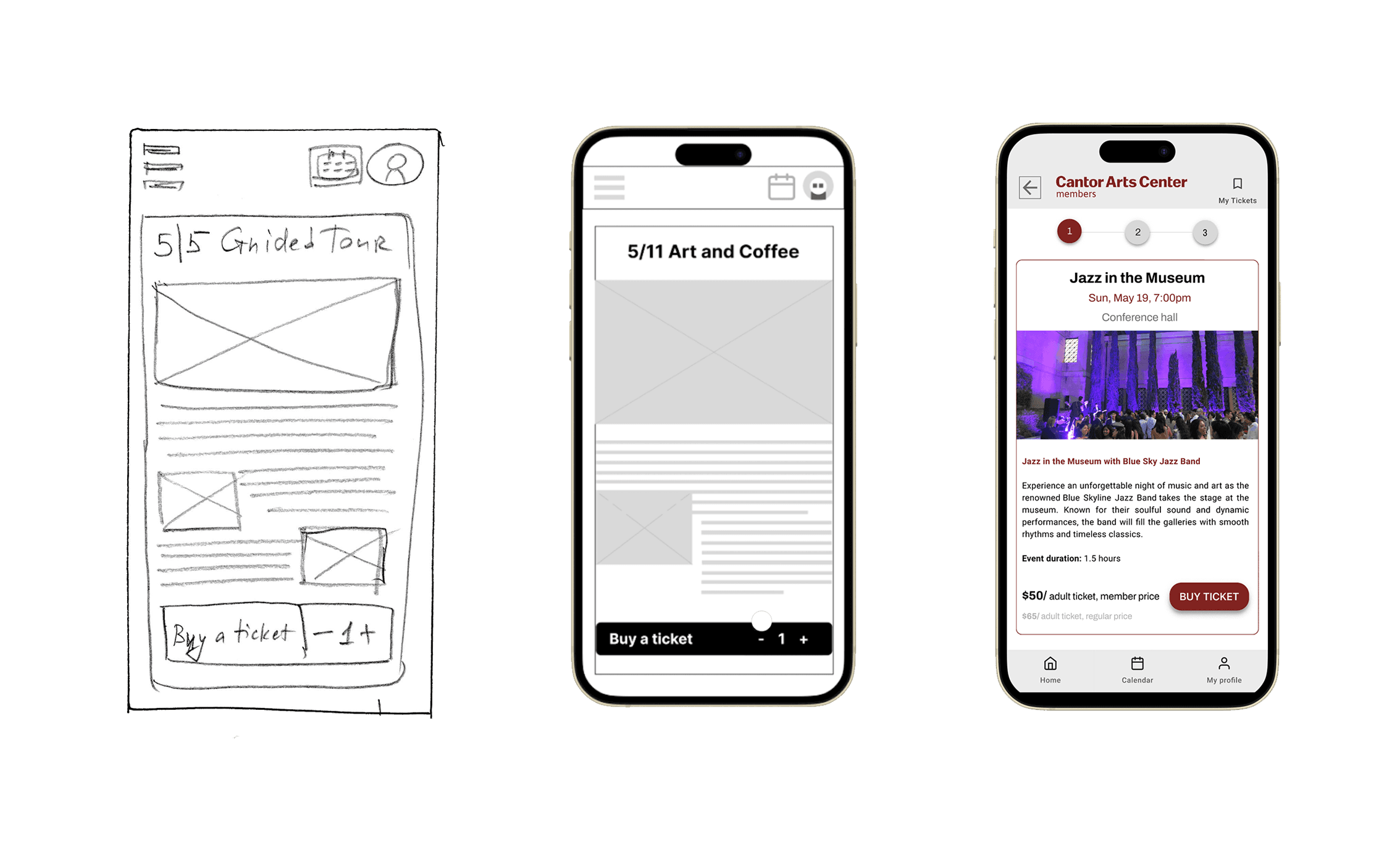
The design process began with hand-drawn sketches exploring different home page approaches, then moved through lo-fi wireframes for structure, and culminated in a high-fidelity prototype using Cantor's existing Stanford brand identity.
Three home page concepts were explored: a personalized recommendation feed, a curated editorial layout, and an interest-based filter approach. The final design blended the best elements of each.
Wireframes
Storyboard
Design System
From Sketch to Hi-Fi
The design process began with hand-drawn sketches exploring different home page approaches, then moved through lo-fi wireframes for structure, and culminated in a high-fidelity prototype using Cantor's existing Stanford brand identity.
Three home page concepts were explored: a personalized recommendation feed, a curated editorial layout, and an interest-based filter approach. The final design blended the best elements of each.
Wireframes
Storyboard
Design System
From Sketch to Hi-Fi
The design process began with hand-drawn sketches exploring different home page approaches, then moved through lo-fi wireframes for structure, and culminated in a high-fidelity prototype using Cantor's existing Stanford brand identity.
Three home page concepts were explored: a personalized recommendation feed, a curated editorial layout, and an interest-based filter approach. The final design blended the best elements of each.
Wireframes
Storyboard
Design System
Lo-Fi Prototype
Usability Testing
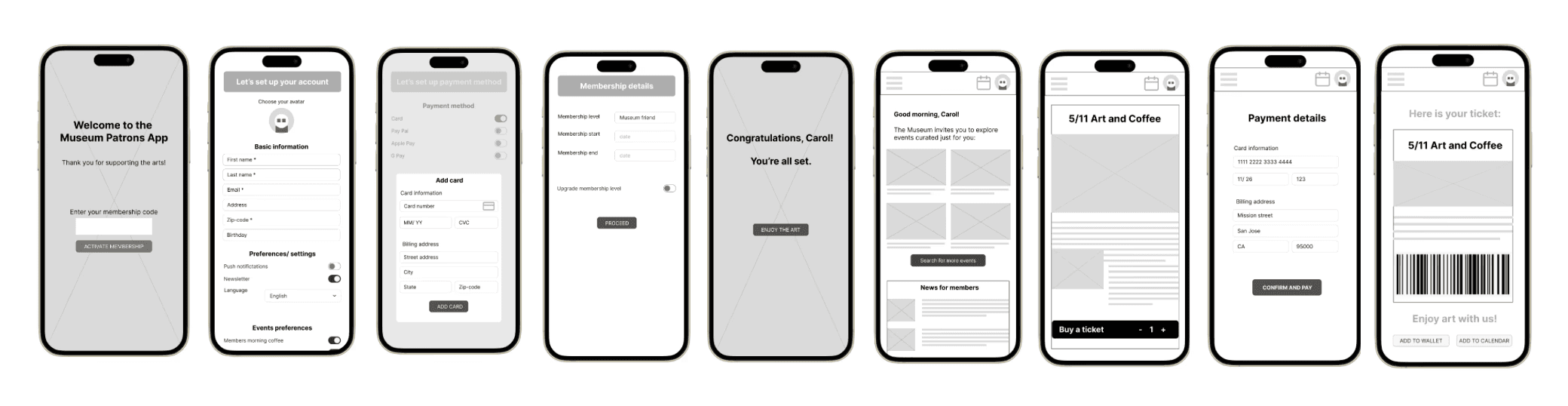
Two rounds of usability studies, one on the lo-fi prototype, one on the hi-fi, drove real, measurable improvements to the design.
Two rounds of usability studies, one on the lo-fi prototype, one on the hi-fi, drove real, measurable improvements to the design.
Round 1: Lo-Fi prototype
1. The Calendar should be clearly organized with specific sorting criteria, users struggled to find events by type.
2. More informative Event Page is needed: type of event, date, time, and day of the week should all be visible.
3. One Profile section is enough, either Avatar or a Menu section, not both (redundancy confusion).
1. The Calendar should be clearly organized with specific sorting criteria, users struggled to find events by type.
2. More informative Event Page is needed: type of event, date, time, and day of the week should all be visible.
3. One Profile section is enough, either Avatar or a Menu section, not both (redundancy confusion).
Round 2: Hi-Fi prototype
1. Event type filtering needed to be surfaced on the home screen, not buried in settings.
2. Apple Pay and Google Pay must appear before other payment methods - matches mental model.
3. Added a back option to the confirmation screen - users felt trapped without a return path.
1. Event type filtering needed to be surfaced on the home screen, not buried in settings.
2. Apple Pay and Google Pay must appear before other payment methods - matches mental model.
3. Added a back option to the confirmation screen - users felt trapped without a return path.
Test → Refine → Repeat
Each round of testing directly informed concrete design changes. The hi-fi prototype was fine-tuned based on Round 2 findings, resulting in a polished, user-validated product ready for development.
Each round of testing directly informed concrete design changes. The hi-fi prototype was fine-tuned based on Round 2 findings, resulting in a polished, user-validated product ready for development.
✓ Calendar sorting criteria added
✓ Event page enriched with date, time, duration
✓ Apple Pay / Google Pay placed first in checkout
✓ Consistent back navigation on all screens
Hi-Fi Prototype
Outcome
A dedicated digital home for
museum members
A dedicated digital home for museum members
A dedicated digital home for museum members
The Museum Members App delivers a complete, user-validated mobile experience. Built through one round of discovery research, two rounds of usability testing, and iterative design, every feature came from something I heard, saw, or tested.
The Museum Members App delivers a complete, user-validated mobile experience. Built through one round of discovery research, two rounds of usability testing, and iterative design, every feature came from something I heard, saw, or tested.
Flexible Event Search Browse by monthly list, event type category, or calendar view
Flexible Event Search
Browse by monthly list, event type category, or calendar view
Flexible Event Search Browse by monthly event list, event type category, or calendar view
Ticket Wallet
Store tickets for quick barcode check-in at any event
Smart Checkout
Saved payment methods & Apple Pay / Google Pay prioritized
Two-Click Booking
Fast, intuitive ticket purchasing with minimal friction
Reflection
Why this project.
I volunteered at the Cantor Arts Center for a year and saw firsthand how much the team cares about its members - and how many member-exclusive events those members never hear about. The only ways to discover them were a monthly newsletter that often went unread, or walking up to the reception desk in person. In Silicon Valley, that gap felt solvable, and a dedicated app was the most direct way to close it.
What I learned.
I interviewed both members and non-members who actively use other entertainment and membership apps, which let me compare expectations across products rather than just within Cantor's audience. The clearest takeaway: user behavior clusters around strong patterns, but meaningful exceptions always exist. Part of the designer's job, alongside the product owner's, is deciding which exceptions to design for now, which to accommodate later, and which to set aside - every edge case deserves to be considered explicitly rather than ignored by default.
What's next.
If I continued the project, I'd prototype the membership sign-up and conversion flow. Serving existing members better is one lever; helping visitors become members in the first place is the bigger one.
Why this project.
I volunteered at the Cantor Arts Center for a year and saw firsthand how much the team cares about its members - and how many member-exclusive events those members never hear about. The only ways to discover them were a monthly newsletter that often went unread, or walking up to the reception desk in person. In Silicon Valley, that gap felt solvable, and a dedicated app was the most direct way to close it.
What I learned.
I interviewed both members and non-members who actively use other entertainment and membership apps, which let me compare expectations across products rather than just within Cantor's audience. The clearest takeaway: user behavior clusters around strong patterns, but meaningful exceptions always exist. Part of the designer's job, alongside the product owner's, is deciding which exceptions to design for now, which to accommodate later, and which to set aside - every edge case deserves to be considered explicitly rather than ignored by default.
What's next.
If I continued the project, I'd prototype the membership sign-up and conversion flow. Serving existing members better is one lever; helping visitors become members in the first place is the bigger one.